
Organizations that invest in communities are rarely short on worthwhile opportunities.
These organizations are often holding several pressures at once. Needs are changing, community organizations are stretched, investment budgets may be constrained, and boards, donors, governments, and communities may each be looking for something slightly different from the same pool of resources. When there are ten strong things to support and resources for three, the hard part is deciding which three the organization is best placed to support and being able to explain how that choice connects to the difference it hopes to make.
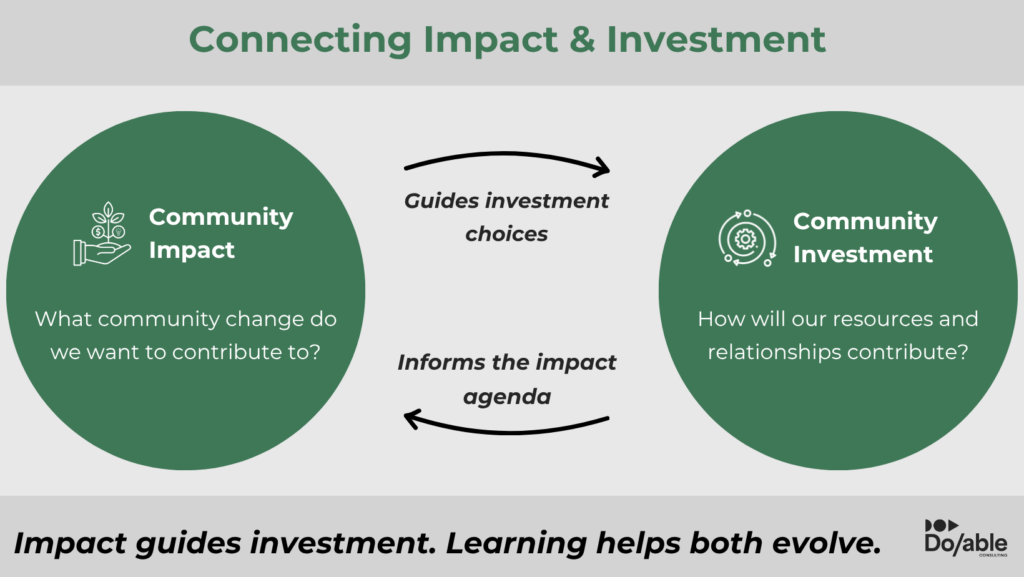
One distinction can make those choices easier to think about. Community impact is the difference an organization hopes to contribute to. Community investment is how it brings resources, relationships, and influence to that work. Seen together, they form a cycle: impact guides investment, investment generates learning, and that learning shapes what comes next.
Understanding Community Impact and Community Investment
Community impact starts with the difference we’re trying to make
That sounds simple but getting there usually requires some real choices.
What difference are we trying to contribute to, for whom, and why are we well placed to play that role?
Community-level outcomes are rarely created by one organization. A foundation, municipality, public agency, or corporate investor has an important role as one contributor among several.
An impact agenda can give that contribution enough shape to guide later choices. We often find the agenda is most useful when it is developed with people beyond the investing organization. People with lived and living experience, community organizations, practitioners, and other interest-holders can help explore what change matters, what role the funder can credibly play, and what may need to be contributed by others.
Community investment turns that direction into action
Once that direction is clearer, investment is the strategy (the group of processes and tools) that the organization uses to contribute to impact. Grantmaking plays a central role, alongside relationships, partnerships, convening, capacity support, and other forms of influence. Each of these plays an important role as part of a coordinated approach. Community investment strategy is how the organization uses the assets it has in service of the impact it has chosen.
How do our investment choices add up to the impact we are hoping to contribute to?
With this question, we’re not focusing on the individual merits of whether each individual grant makes sense. An organization can make a series of perfectly reasonable grants and not end up with a portfolio that adds up to a clear impact strategy. When looking at the portfolio as a whole we’re often asking what all the grants in the portfolio, taken together, contribute to the impact the organization is trying to make. That might look like one or more granting streams, calls for proposals, partnerships, service networks, or collective impact approaches, in service to an intended community result.
How We Approach the Work
Funders come to this work from different starting points. Sometimes the challenge is strategic: the impact agenda no longer gives enough guidance. Sometimes the direction is clear, but the investment process is not translating it into useful choices or learning. Sometimes the landscape has evolved with changes in funder roles, community trends, and resources. We can help diagnose where the need for calibration or evolution of the impact or investment approach sits, bring the relevant evidence and perspectives together, and facilitate the decisions needed to reconnect impact and investment.
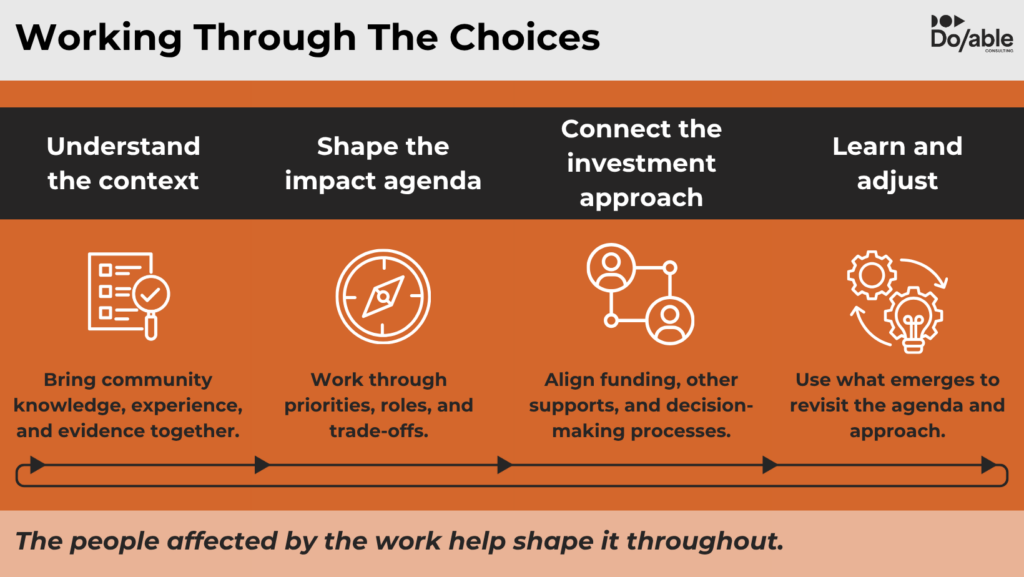
We tend to think of it as a process of gathering learning, sensemaking, choice, and adjustment, with the people affected by the work involved at meaningful points along the way.
Understanding the context together
A useful starting point is to ask what the organization knows about the community now and what it may be missing. Research, trends, and existing evidence can help alongside a clear look at the organization’s own mission, resources, relationships, and capacity. The purpose is to understand enough of the context to see where a credible contribution is possible.
That picture becomes richer when it includes different kinds of knowledge. People with lived and living experience may notice barriers or possibilities that formal data misses. Community organizations and practitioners can speak to what it takes to respond in practice, while donors and other funders may bring a wider view of stewardship, gaps, or overlapping efforts. These perspectives will not always agree, but together they can make the choices in front of the organization more visible.
Working through the choices
Once those perspectives are on the table, tension is normal. What matters most in community may not line up neatly with mandate, capacity, or what the organization can credibly influence. That tension is often where the real strategic work begins.
We bring the evidence and perspectives into the same conversation, help groups surface the trade-offs they are actually facing, and create enough structure to work through choices without pretending there is a single objective answer. The aim is to help the people responsible make the decision with greater clarity about what they are choosing and why.
That is also where an organization development lens can be useful. The quality of the choice depends partly on the information available and partly on how people make sense of it together: whose knowledge is present, where power sits, what can be said openly, and how disagreement is handled. Criteria and decision tools can create useful structure, but they cannot substitute for that human work.
From sensemaking to an impact agenda
The sensemaking can be translated into an impact agenda that is specific enough to guide real choices.
Depending on the organization, that may include:
- the community change the organization is trying to contribute to
- the outcomes that would indicate progress
- the organization’s credible role
- the contributions needed from others
- the boundaries that will guide future choices
An impact agenda gives the organization a shared reference point for making choices. It helps people assess opportunities, funding decisions, partnerships and trade-offs against the change they are trying to contribute to, so individual investments can add up to a more coherent contribution over time. It also creates a basis for learning: as community conditions change and results emerge, the organization has something concrete to revisit, test and adapt.
Connecting investment strategy to the impact agenda
With an impact agenda in place, the next conversation is about what kinds of investment make sense. What sorts of grantmaking will be utilized. Alongside funding, what mix of relationships, influence and awareness, capacity support, convening, and learning could help this particular agenda move forward? And, what sorts of decision-making processes will be used, who will participate in them, and how will they be convened and facilitated?
This is where the impact work begins to shape the investment system rather than sitting beside it and investment choices have something concrete to organize around. It becomes easier to see where investments are reinforcing one another, where there may be gaps or over-concentration, and whether the overall pattern of support is still aligned with the impact the organization hopes to contribute to.
Keeping the process purposeful
Applications, reporting, and evaluation are all opportunities to make an investment approach more purposeful. When each part of the process is clear about what it is trying to support, funders can make better-informed decisions, community organizations can better understand what matters, and both can learn more from the work over time. A question we often bring to a review is simple: what decision, relationship, or learning need is this part of the process serving?
Looking at the full process this way can help identify where requirements are adding value, where they could be lighter or more purposeful, and where different approaches might create better information or stronger relationships. It can also surface questions of accessibility and burden, particularly for smaller, grassroots, culturally specific, or community-led organizations with less administrative capacity. The opportunity is to create an investment process that supports good decisions, meaningful accountability, useful learning, and participation from the organizations and communities whose knowledge matters to the impact agenda.
Learning and adjusting over time
Ongoing learning helps an impact agenda and investment approach stay useful as conditions change and experience accumulates. It gives funders and community partners a way to notice what is working, where assumptions may need to shift, and what new opportunities are emerging.
That learning does not need to be burdensome. Thoughtful evaluation, reflection, and conversation can be built into the work in proportionate ways, drawing on information that is already being generated wherever possible. Over time, those insights can strengthen individual investment decisions, improve the portfolio as a whole, and help the impact agenda continue to evolve with the community.
What This Makes Better
Connecting community impact and community investment can help strengthen at least four major conditions.
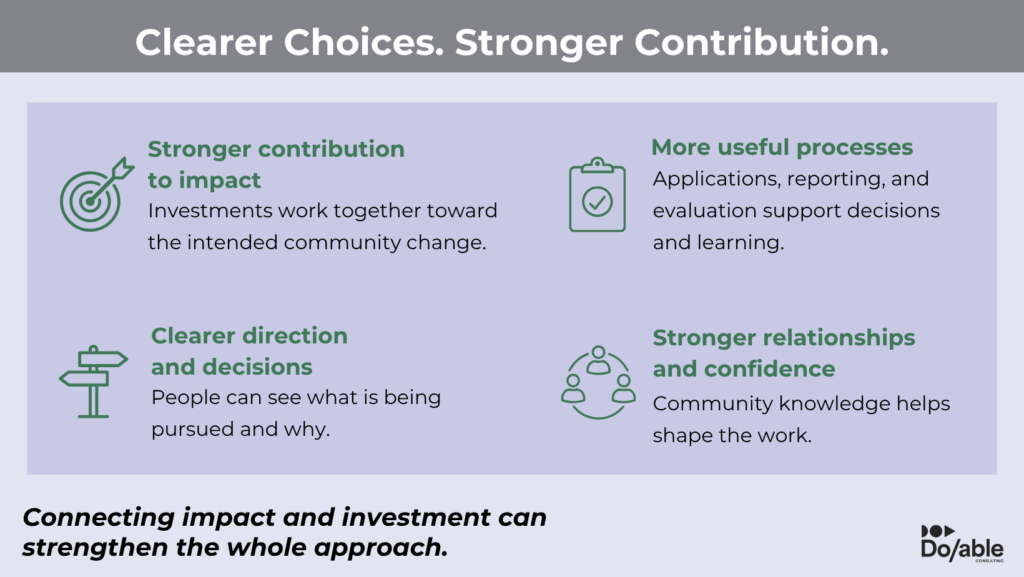
Stronger contribution to impact: A clearer line of sight between the change being pursued and the investments being made helps organizations focus resources, relationships, and attention where they are most likely to contribute. It also makes it easier to see whether the portfolio as a whole is adding up to the intended impact.
Clearer direction and decisions: Leaders, boards, staff, and partners can understand the impact being pursued and why resources are being directed in particular ways. People may not always agree with the outcome, but they can understand how and why a decision was made.
More useful processes: Applications, reporting, and evaluation provide information that supports decisions and learning without creating work simply for the sake of process. And other supports can be leveraged to activate investments for the greatest result.
Stronger relationships and confidence: People and organizations affected by investment decisions have a meaningful role in shaping the work, and their knowledge, time, and capacity are treated with greater respect. Partners, donors, and community organizations have greater visibility into how the process works and where they fit.
For organizations beginning this work or revisiting a longstanding approach, clarity, participation, and learning provide a practical foundation. Together, those conditions can support more coherent impact, more thoughtful choices, and greater ability to adapt as conditions change.
Let’s Keep the Conversation Going
Your organization may be shaping a new impact agenda, revisiting longstanding funding processes, exploring the role of other supports, or looking for a clearer connection between the three. All are a useful place to begin.
Do/able can join at the point where the question feels hardest: clarifying the impact you want to contribute to, working through competing perspectives, or figuring out how an existing investment approach can evolve. We can help create the process, facilitate the conversations, and translate the resulting direction into practical investment choices.
If you’re considering what this could look like in your context, we’d be glad to talk it through.