
Most organizations and collaboratives do not start thinking about organization or network development because they want to redesign how they work. More often, they start noticing friction: the work is getting done but it is taking more effort than it should.
People create workarounds because roles or processes are unclear. Decisions take too long or keep coming back to the table. Teams may be committed to the same purpose but working from different assumptions about how the work should happen. Leaders may sense that a structure, culture, or way of working that once served the organization well no longer fits what it is being asked to do. Those pressures are showing up more often as organizations navigate tighter capacity, frequent change, new technology, and work that increasingly crosses team and organizational boundaries.
Across organizations, partners can genuinely want to work together and still find themselves circling the same questions: What are we really trying to accomplish together? Who is best placed to do what? Which decisions belong to the collective? How do we share leadership, information, resources, and responsibility? What does each organization need to contribute, and what does it need to get back from participating?
These challenges have practical consequences. Unclear decisions consume time. Weak coordination creates duplication and gaps. Structures that no longer fit make ordinary work harder. Strained relationships reduce the ability to work through disagreement or change. A collaborative with strong intentions can still struggle to turn those intentions into coordinated action.
When the way work is organized no longer fits what people are trying to accomplish, valuable capacity gets spent working around the problem.
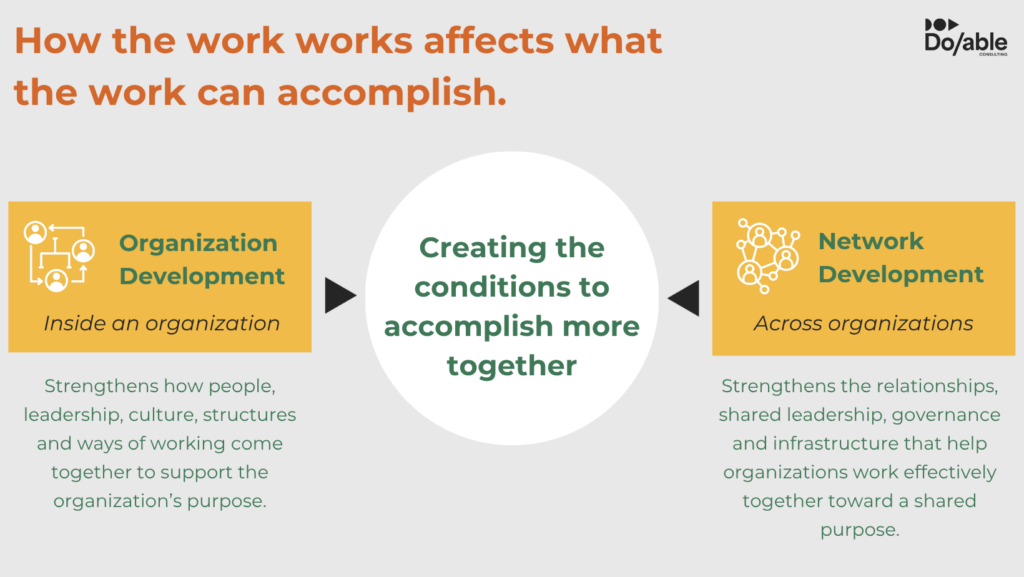
How the work works affects what the work can accomplish.
What Do We Mean by Organization and Network Development?
Organization Development is intentional work to strengthen the fit between an organization’s purpose and environment and its people, culture, leadership, structures, systems, and ways of working. Sometimes that means addressing something that is getting in the way now: unclear roles, difficult decision-making, strained relationships, a structure that no longer fits, or a team navigating significant change. Other times the opportunity is more forward-looking: preparing for growth, developing leadership capacity, shifting culture, redesigning how work is organized, implementing strategy, integrating new technology or services, or building the ability to adapt as circumstances change.
Network development focuses on the conditions that allow organizations to work effectively across organizational boundaries toward a shared purpose. Networks operate differently from individual organizations. There is no single decision-maker. Each participant brings their own mission, culture, accountabilities, resources, relationships, and pressures. Leadership is often shared or distributed, and participation needs to create value for the collective while continuing to make sense for the organizations involved. That makes questions of shared purpose, trust, reciprocity, governance, decision-making, contribution, power, communication, and enabling support especially important.
Both matter because they shape whether purpose and strategy can become effective action.
An organization can have a strong strategy and still struggle if authority is unclear, teams work at cross-purposes, culture discourages the behaviours the strategy requires, or the structure makes implementation unnecessarily difficult. A network can share an ambitious purpose and still make limited progress if members are unclear about decisions, contributions, leadership, or how the collective work will be supported.
Organization and network development invest directly in those conditions.
Where Development Creates Leverage
Organizations and collaboratives have no shortage of demands on their time, capacity and resources. The case for organization and network development becomes clearer when we look at how directly these conditions affect the work itself.
Inside an organization
The work might involve organizational design and structure, roles and accountabilities, team alignment, leadership practices, decision-making, communication and coordination, culture, governance-management relationships, capabilities, or how people experience and lead change.
These conditions are interconnected.
Structure affects how work moves. Roles and authority affect whether people can make decisions and act. Leadership practices influence clarity, confidence, and how responsibility is shared. Culture affects how people actually behave when priorities compete, disagreement appears, or circumstances change. Communication and coordination determine whether people can combine their work toward organizational outcomes.
What appears to be one issue often has several contributing conditions. A role problem may also involve authority and decision-making. A new structure may struggle because behaviours and relationships have not shifted with it. A culture concern may be reinforced by incentives, systems, leadership practices, or assumptions about whose voice carries weight.
The opportunity is to understand where changes to these conditions will create the most leverage for the work the organization exists to do.
Across a network or collaborative
The same principle applies across organizations. Partners may need greater clarity about shared purpose and the value the network creates. They may need to work through governance, shared leadership, decision-making, roles, communication, relationships, or how responsibility is distributed across members.
Networks also need enabling infrastructure. Someone may need to convene, coordinate, communicate, steward information, support shared learning, or keep collective work moving between meetings. These functions can be held by a backbone organization, shared among partners, or supported externally, but they still need to exist.
Differences in power, capacity, resources, and risk also matter. A small community organization and a large institution may both have a seat at the table while experiencing participation very differently. Making those dynamics visible can help a collaborative make better choices about participation, contribution, leadership, and whose knowledge shapes the work.
The value of network development is practical: it helps create enough clarity, trust, infrastructure, and shared practice for organizations to accomplish something together that none could accomplish as effectively alone.
Relationships are Part of the Operating Infrastructure
Across both organizations and networks, relationships underpin much of this work.
People do not need to agree on everything to work effectively together. They do need enough trust, communication, and reciprocity to contribute honestly, work through disagreement, rely on one another, and make use of different perspectives and strengths.
Relationships affect how information moves, whether people raise concerns early, how readily expertise is shared, and whether people can make decisions without protecting only their own role, department, or organization. Inside organizations, formal roles and authority provide additional structure. Across networks, there may be fewer formal mechanisms to fall back on, which makes relational capacity particularly important.
Relationships also determine whether formal changes become useful in practice. An organizational chart can clarify reporting relationships, a governance model can describe who decides what, and a memorandum of understanding can document what partners agreed to. How people actually behave when something is uncertain, contested, or under pressure tells us whether those structures are doing their job.
Trust, reciprocity, and strong working relationships are resources, in their own right, that increase the ability of people and organizations to coordinate, adapt, solve problems, and act together.
How Does Do/able Approach the Work?
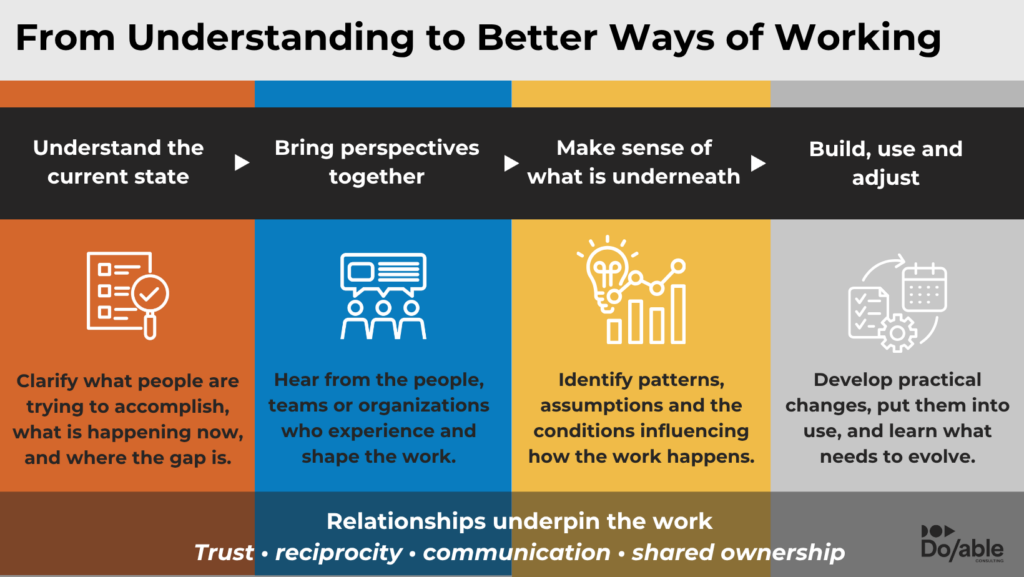
There is no single organization or network development process that fits every situation. Do/able starts by helping clarify what the organization or collaborative is trying to accomplish, what is happening now, and where there may be a gap between the two. That matters because the first visible problem is not always the most useful place to intervene. Repeated decision delays may involve unclear authority. A role problem may also involve trust or communication. Difficulty sustaining a collaborative may point back to an unclear shared purpose, uneven expectations among members, or insufficient capacity to support the network.
We bring together different perspectives to build a fuller picture. People closest to the work often see things that formal structures cannot show. Staff know where workarounds have developed. Leaders see organizational pressures and trade-offs. Partners experience how responsibilities move across organizational boundaries. Community members and people affected by the work may see consequences that are less visible from inside the system.
An external perspective can also help. Everyone inside an organization or network occupies a position within it. We can help surface patterns across teams, roles, and organizations; make assumptions and tensions easier to discuss; and create space for perspectives that may otherwise remain disconnected.
From there, we facilitate shared sensemaking. The aim is to understand what sits underneath the most visible issues, distinguish symptoms from contributing conditions, and identify where change could make the greatest difference.
Then the work becomes gets right into it. That might mean clearer roles or decision authority, organizational-design principles, changes to governance, a team agreement, leadership or culture practices, a network operating model, enabling supports, or a different way for partners to coordinate their work. The work continues into use. People try the new approach in real conditions, notice what happens, and adjust as they learn. That helps move a new structure, agreement, or practice from something that works on paper to something that actually helps the work.
What Changes When This Work is Done Well?
The larger return is straightforward: more of the organization’s or network’s capacity can go toward accomplishing its purpose.
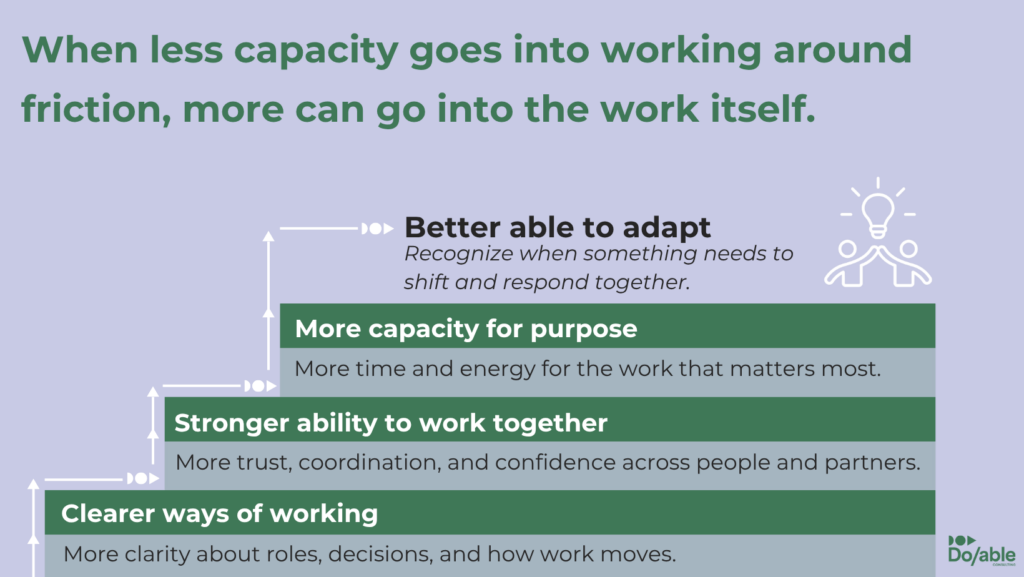
Some changes are visible in the mechanics of work. Roles and expectations become clearer. Information moves more easily. Decisions happen with the right people involved and closer to where relevant knowledge sits. People spend less time navigating unnecessary ambiguity, duplicating effort, or revisiting decisions.
Other changes are relational and cultural. People may have more confidence in one another, greater clarity about how their work connects, and a stronger ability to work through disagreement or change. Leaders may become more comfortable sharing authority. Network members may have greater confidence about what they are contributing, what they can expect from one another, and why the collective work is worth their investment.
Organization and network development can also make better use of capacity that is already there. Clearer roles and decisions can reduce avoidable friction for teams and leaders, while stronger coordination can help partners connect existing knowledge and resources more effectively.
Over time, another return emerges: greater organizational or collaborative capability. People become better able to recognize when a structure, relationship, practice, or assumption no longer fits, talk about it openly, and work through what needs to change.
Organization and network development can sound abstract. In practice, the value is very concrete: they create better conditions for an organization or collaborative to accomplish the work it exists to do.
Let’s Keep the Conversation Going
You do not need to know exactly what needs to change before beginning this work. Often, the first useful step is understanding that something that once worked is becoming harder, where an emerging opportunity may require a different way of working, or why a collaborative with good people and good intentions is struggling to get traction.
Do/able can help organizations and collaboratives understand what is happening, bring the right perspectives into the conversation, and build practical ways forward that fit the work and the people doing it.
We’d be glad to talk it through.
For a wider look at what these shifts mean for organizations and networks, read Can Our Ways of Working Keep Up? for our take on how ways of working need to evolve as more of the work crosses traditional boundaries.