
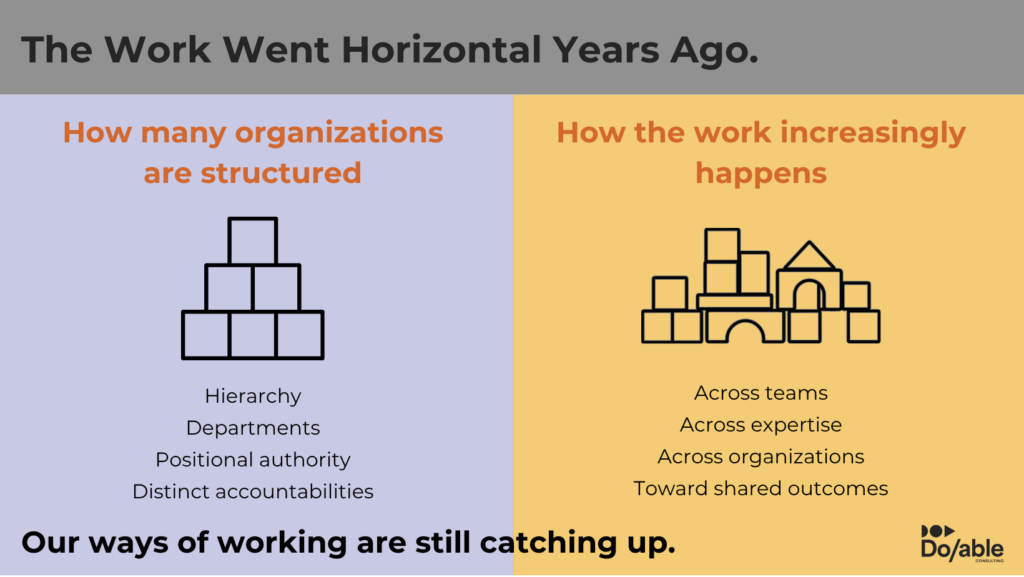
The work went horizontal years ago.
Inside organizations, results have long depended on people being able to work across teams, departments, disciplines, and reporting lines. Strategic priorities rarely fit neatly within one function. Expertise sits in many places, and getting meaningful work done often depends on people combining what they know and what they can do.
Across organizations, the same is true at a larger scale. Community-serving organizations work through partnerships, integrated services, networks, coalitions, and collaboratives because many of the outcomes they care about cannot be produced by one organization acting alone.
Yet many of our inherited assumptions about organizations and leadership remain surprisingly vertical. We have strong traditions of hierarchy, departmental responsibility, positional authority, and accountability for distinct organizational missions. Governance, funding, management, and reporting systems have often grown around those same boundaries.
Those structures and clear lines of authority still matter. Organizations remain responsible for their missions, people, resources, and commitments. But the work increasingly requires people to operate across those boundaries at the same time.
That can mean a department contributing to an outcome it does not own, or a leader relying on expertise they do not personally hold. An organization may need to advance its own mission while contributing to a larger community outcome, and a network may need to move quickly around an opportunity before everyone has perfect certainty about what comes next.
Sometimes the gap between our ways of working and what the work requires shows up as friction. Decisions stall, responsibilities blur, people work around a structure that no longer fits, or a collaborative keeps relying on the same organization to carry the work. Sometimes we can see the gap coming: growth, a leadership transition, culture change, a new strategy, technology, changing community needs, or an emerging partnership asks something different of the organization or network.
Either way, the question is worth asking: Do our ways of working fit what we are trying to accomplish now? The work has already changed. Many of our assumptions about leadership, culture, and development are still catching up.
Horizontal Work Needs Something to Organize Around
When work crosses boundaries, authority, expertise, relationships, and the capacity to act are distributed. No leader can see everything happening in an organization, and frontline teams will always understand parts of the work that senior leaders cannot see directly. Different departments hold different expertise; across networks, each organization brings its own knowledge, relationships, infrastructure, resources, credibility and connection to community.
That distribution creates potential. A cross-functional team or network becomes valuable when bringing those different capacities together creates something that no one participant could create alone. But distributed capacity does not organize itself.
Shared purpose becomes especially important when people cannot rely on hierarchy or organizational boundaries to tell them what matters most. Inside an organization, shared purpose helps people see beyond the success of their own role or department toward the larger outcome they are helping create. Across a network, it gives organizations with different missions and accountabilities a compelling reason to invest time, resources, and leadership in something collective.
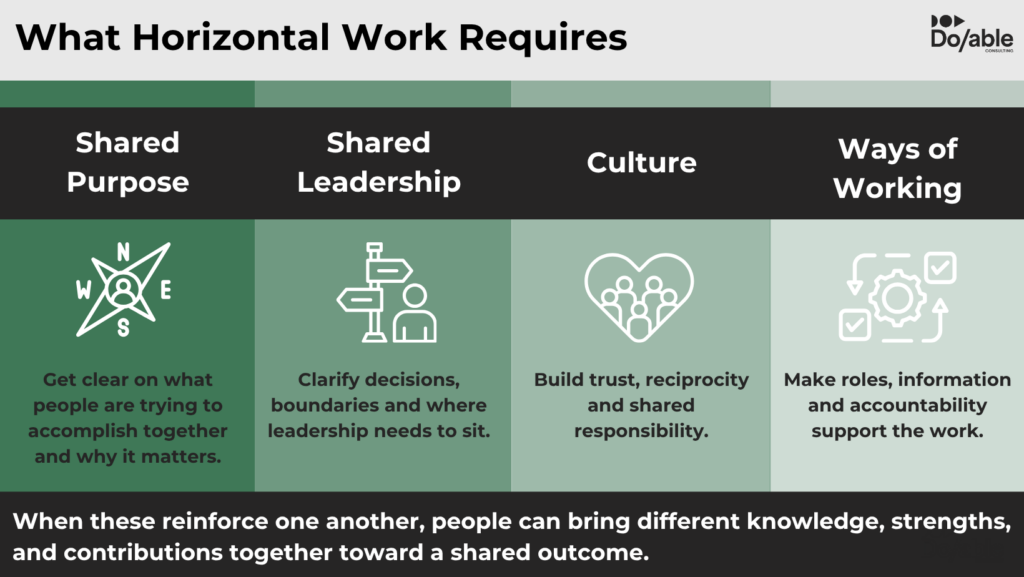
Without enough clarity about what people are trying to accomplish together, horizontal work can become a lot of coordination without much added value. With it, people have a stronger basis for deciding what needs to be shared, where leadership should sit, what each participant can contribute, and what can be accomplished together that would be harder to accomplish apart.
Leadership, culture, and ways of working have to support it
Shared purpose gives distributed capacity somewhere to go. Leadership, culture, and the practical ways work is organized determine whether people can actually get there.
Leadership in this environment cannot depend on one person having all the answers or making all of the decisions alone. It increasingly involves creating clarity about purpose and boundaries, knowing when a decision needs clear authority, and knowing when the work will be stronger if expertise, initiative, or leadership sit somewhere else or are shared.
That applies inside organizations as much as it does across them. Departments need to contribute to organizational outcomes rather than optimize only for themselves, and teams need to draw on expertise wherever it sits. Around a collaborative table, leaders have to contribute to a shared purpose without losing sight of their own organization’s responsibilities.
Culture shapes whether people are able to work this way. Trust, reciprocity, curiosity, constructive disagreement, and shared responsibility all matter more when work crosses boundaries. So does the willingness to admit that no one person, team, or organization holds the whole answer. Culture also shapes what happens within teams and organizations more broadly: whether people can raise concerns, work through disagreement, take initiative, learn from what is happening, and adapt how they work together.
The structures that underpin the culture have to reinforce those behaviours. Decision-making, governance, team structures, information flows, roles, incentives, accountability, and enabling supports all send signals about how people are really expected to work.
A strategic priority may cross four departments while each one is still rewarded for protecting its own piece. A decision model may describe distributed authority while every meaningful choice still travels upward. A collaborative may speak about shared ownership while one organization quietly carries most of the coordination.
Those gaps matter because they consume capacity and make collaboration harder than it needs to be.
Stronger organizations and networks are able to align shared purpose, leadership, culture, and practical ways of working so that they reinforce one another. That is how distributed knowledge and capacity start to become collective capability. In practice, this does not necessarily look dramatic. It can mean clearer decisions about who owns what, teams that regularly make sense of what is changing around them, leaders who know when to hold authority and when to share it, and structures that can be adjusted when they stop serving the work. It can mean surfacing tension earlier, revisiting roles as the work evolves, and making reflection and learning part of how people work together.
Build the Capacity Before You Need It
We still often invest in organization or network development when something significant happens: a restructure, leadership transition, shift in organization culture, stalled collaborative, governance change, or major new partnership.
Those moments will always need focused attention. But many organizations and networks now operate in environments where change does not settle down for long. Community needs and expectations shift. Technology changes the work. People and leadership change. Funding and policy environments move. Partnerships evolve. Strategies adapt. New opportunities appear.
A way of working that fits today can become less useful over time without anyone having done anything wrong.
That is why organization and network development increasingly need to become ongoing capabilities. Organizations and networks benefit from being able to notice when something is changing, make sense of what it means for how they work, adjust deliberately, practice new approaches, and learn from what happens.
That capability can live in different places. Leaders and teams can develop it internally. Networks can build it collectively. Backbone organizations and conveners can provide continuity, coordination, relationship stewardship, and shared learning. External facilitators and consultants can create neutral space, connect perspectives, support difficult transitions, and help people see patterns that are hard to see from inside the system.
The important thing is that there is enough capacity to work on how the work happens before circumstances force the issue.
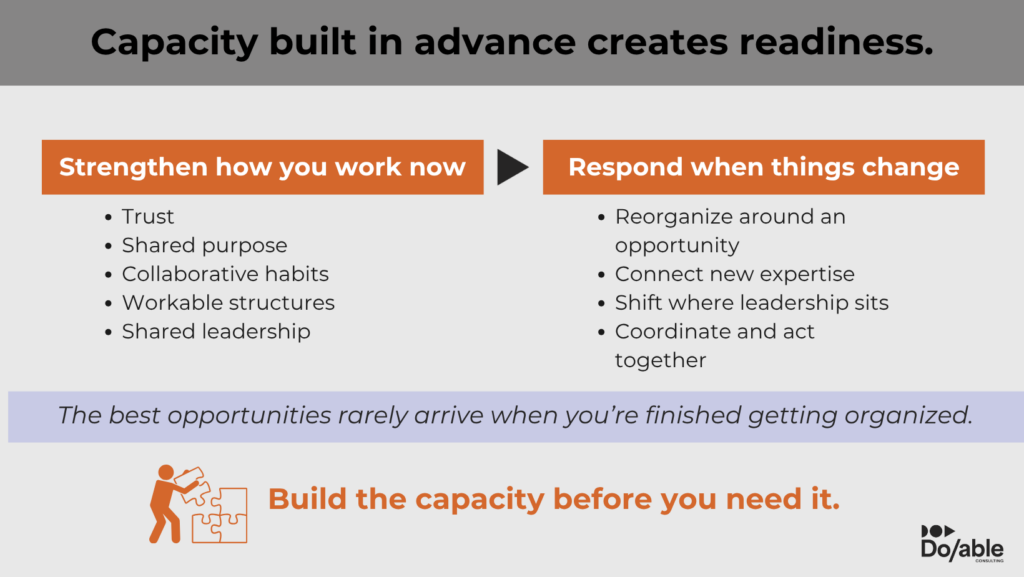
Its value becomes especially clear when things move quickly. An opportunity, new technology, changing community need, or emerging partnership may suddenly require people to reorganize, connect different expertise, shift where leadership sits, or coordinate action in new ways. Organizations and networks that have already built trust, shared purpose, collaborative habits, workable structures, and experience sharing leadership are better positioned to respond.
Capacity built in advance creates readiness. And readiness matters because the best opportunities rarely arrive at the moment an organization or network has finished getting itself organized.
Make More of the Capacity Already There
Community-serving organizations and networks are already operating in a world of interdependence, distributed expertise, shared outcomes, and ongoing change.
The opportunity is to build ways of working that make better use of the intelligence, relationships, and capacity already present. Inside organizations, that can mean stronger alignment across teams, healthier culture and leadership practices, clearer roles and decisions, and structures that support the work people are actually trying to accomplish. Across networks, it can mean connecting the distinct strengths of participating organizations into a collective capability that none could create alone.
The organizations and networks best positioned for what comes next will be able to keep evolving how they work without losing sight of what they are trying to accomplish together.
When the work keeps changing, how we work together has to remain something we are capable of changing too.
Let’s Keep the Conversation Going
If your organization or collaborative is feeling the gap between how the work needs to happen and how it happens now, that is a useful place to start.
Do/able can help create the conditions for that development, whether the opportunity sits inside an organization, across a network, or in the space between them.
We’d be glad to talk it through!