
Has evaluation become more about proving than learning? What does the community serving sector lose when learning gets crowded out of program design, evaluation, and service review?
Community serving organizations and collaboratives rarely lack commitment, expertise, or information about how their work could be stronger.
Across organizations and collaboratives, people hold different pieces of the picture. Staff see where people are getting stuck. Participants and community members know where programs, services, and initiatives fit their lives and where they do not. Partners see connections, gaps, and duplication across a system. Leaders understand the broader pressures shaping difficult decisions.
The challenge is often finding enough space to bring those perspectives together, make sense of them together, and decide what they mean for the work.
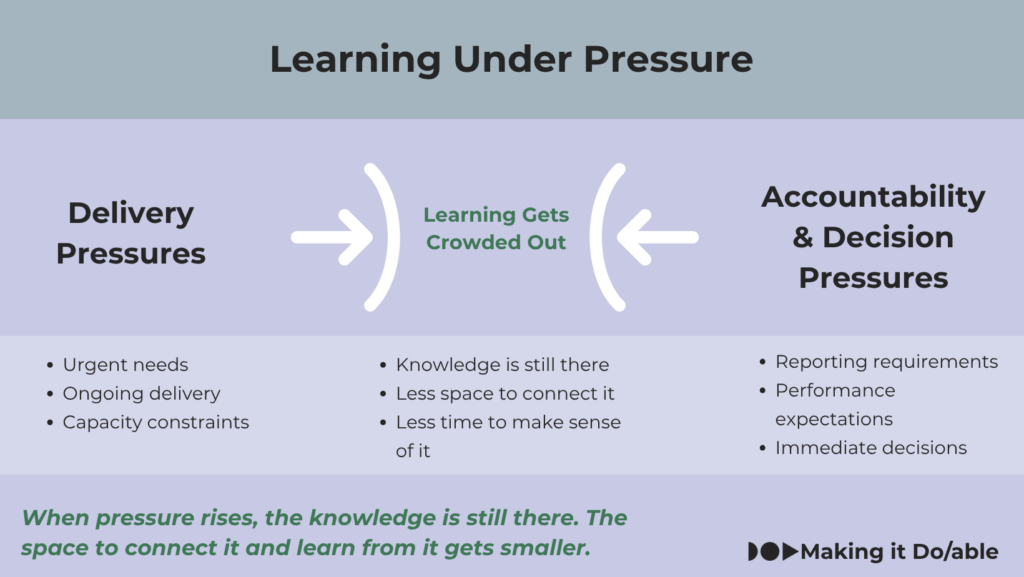
And that is becoming increasingly difficult. As demand grows, programs fill, participation patterns shift, capacity stretches, and funding and accountability pressures intensify, stepping back can feel difficult to justify. The operational pressure is to keep delivering: support the next participant, meet the next target, complete the next report, and respond to the next immediate need or opportunity.
These pressures shape how organizations and collaboratives are able to approach program design, evaluation, and service review. Design may be compressed into the work required to secure funding and launch a program or initiative quickly. Evaluation may become organized around required indicators and reporting cycles. Service review may arise when efficiency, restructuring, or difficult resource decisions become urgent.
These are real pressures. Organizations, collaboratives, funders, governments, boards, and other partners all have responsibilities for resources, results, and accountability.
The challenge is what can get crowded out along the way.
Across the community serving sector, we have built strong systems for planning, delivering, counting, and reporting. We have built fewer structures for making collective sense of what the work is teaching us while we do it.
Under those conditions learning can begin to feel separate from the real work.
We think learning has to be part of the real work.
Programs, Services, and Initiatives Evolve, Whether or Not There is Time to Redesign Them
Few long-standing programs, services, collaborative initiatives, or service networks look exactly as someone would design them today.
Organizations and collaboratives are constantly adapting. Community needs and participation patterns shift, funding priorities and policy environments evolve, new partnerships emerge, and staff and partners find practical ways to respond to challenges and opportunities as they arise.
Most of these adaptations are thoughtful responses to real circumstances, made with the best information and resources available at the time.
They also tend to happen gradually, one decision at a time. A new activity is added to meet an emerging need or opportunity. Staff develop a workaround to keep a program accessible or running smoothly. Partners divide responsibilities according to the capacity available at that moment.
Over time, the work evolves while the shared understanding of it may still reflect an earlier blueprint. The systems for learning, coordination, and reflection may not develop at the same pace as the programs, services, initiatives, and networks themselves.
That matters because accumulated adaptations eventually become the model.
Intentional learning creates an opportunity to reconnect what is happening now with the needs, opportunities, purpose, values, and outcomes that guide the work.
- Are we still responding to the right needs and opportunities?
- Is the value or contribution of the work clear?
- Are people experiencing the work as intended?
- What have staff, participants, partners, and community members learned that has not yet shaped the model?
- Which parts of the work are helping, and which are creating friction?
- What could continue, change, connect differently, or conclude in the current environment?
These are learning questions. They are central to quality, staying connected to mission, and making a meaningful difference in our communities.
It's possible to have information without having useful learning
Community serving organizations and collaboratives are surrounded by information.
Some of it is formal: program and service data, outcome measures, financial information, participation trends, surveys, research, and reports. Some of it is experiential: what staff notice, what participants say, what community members experience, and what partners see from other parts of a service pathway or system.
The issue is not the absence of knowledge. It is that knowledge is distributed.
Different people, organizations, networks and systems see different parts of the work, and the structures available to bring those perspectives together may be limited.
Data can remain in dashboards and reports, while participant stories support communications without shaping program decisions. Staff may repeatedly identify the same operational challenge without having a place to explore its wider causes, and partners may see gaps in a service network differently depending on where they sit. Gathering more information will not necessarily resolve that.
Reports can capture learning, but they do not create it.
Useful learning happens when people can bring what they know together, notice patterns and tensions, challenge assumptions, and decide what it means for the work.
That distinction matters across the sector. When our systems generate information without creating enough opportunity to learn from it, much of what organizations, collaboratives, communities, and partners know remains fragmented.
Three Practices, Different Opportunities to Learn
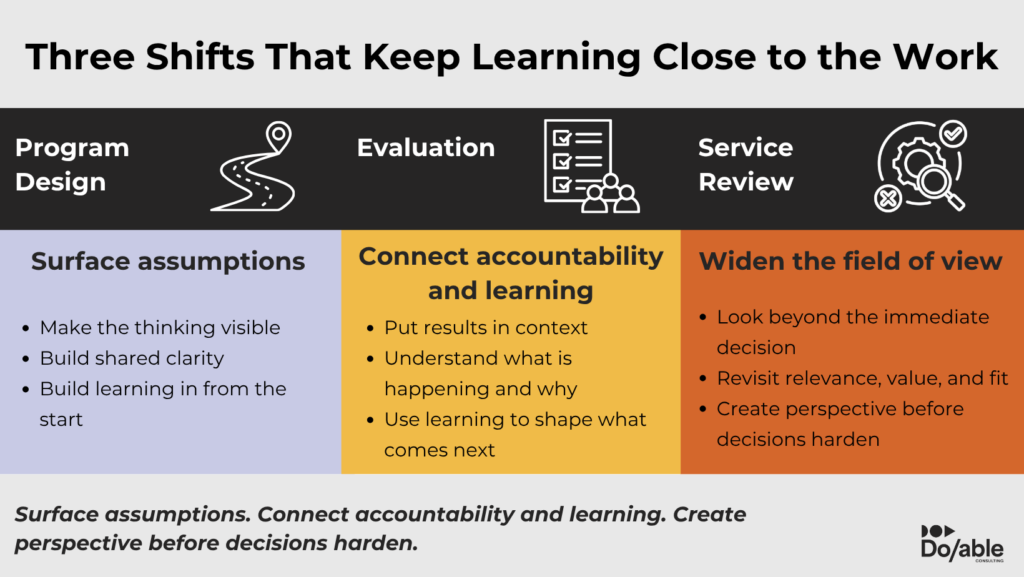
Program design can make assumptions visible
Program design often happens under pressure.
Funding timelines and immediate community needs can create pressure to move quickly from identifying a problem to deciding what the program will do. For collaboratives, the same pressure can accelerate decisions about an initiative, shared service, or network before partners have fully explored how they understand the problem or their respective roles in addressing it.
Every design contains assumptions about what people need or value, how change is expected to happen, who will contribute what, and what conditions need to be in place for the work to succeed.
Those assumptions are easier to work with when they are visible.
Design can create space to bring different forms of knowledge into the same conversation and ask whether people are actually working from the same picture.
That is one of its most valuable contributions. Before a program, service, or initiative becomes a set of activities and deliverables, design can help people become clearer about what they are trying to accomplish, why they believe their approach could work, and what they will need to learn as implementation unfolds.
The opportunity is larger than producing a good plan. It is creating enough shared clarity that the plan can adapt when reality teaches us something new.
Evaluation can be reclaimed as a learning practice
Evaluation has become closely associated with reporting, performance targets, and demonstrating that resources were used as promised. Those purposes matter: organizations, collaboratives, funders, governments, and communities all need credible information about what work and investment are accomplishing.
But accountability can become the dominant frame.
Across the sector funding, governance, accountability, and reporting environments can place significant emphasis on volumes, outputs, contractual obligations, and reporting cycles. Organizations and collaboratives understandably build much of their information infrastructure around what those environments require. Measures that are easy to count can become more prominent than questions that would help people understand why something is happening, for whom, under what conditions, and what should happen next.
That can leave an organization able to say how many people participated while knowing much less about who was not reached, how people experienced the work, why outcomes differed, what staff and partners had to do behind the scenes to make it possible, or whether the current model remains the best use of limited capacity.
This is not an argument against accountability. Accountability and learning can strengthen one another. When learning is part of evaluation, accountability can become more meaningful because it gives numbers and outcomes context. It helps explain what contributed to results, what remains uncertain, and what people intend to do with what they learned.
We need to reclaim evaluation as a learning practice.
Evaluation can reduce uncertainty. It can test assumptions, explore what is contributing to results, notice unintended effects, and give organizations and collaboratives a stronger basis for decisions.
The important questions become: What can we credibly demonstrate? What are we learning? What will we do with that learning?
That is a different relationship with evaluation. The aim is not simply to produce an account of the work after it happens. Evaluation can help people learn more about the work while they still have time to shape it.
Service review can create perspective before decisions harden
Service reviews often arise during periods of pressure. Funding may be uncertain, demand or participation may have shifted, and partners may be reconsidering their roles. A service network may have become difficult to navigate. Leaders may need to make consequential choices about priorities and resources.
Those moments can quickly narrow the conversation toward efficiency, affordability, or whether something should continue.
Those are legitimate questions. A review creates an opportunity to widen the field of view before decisions harden.
A service may appear efficient while creating barriers for participants, and two programs may look duplicative while actually serving different people or purposes. Staff workarounds may be consuming significant capacity, or a collaborative service network may still reflect relationships and assumptions that have changed.
A review can help an organization or collaborative understand how a service or service network is functioning now, whether it remains relevant and accessible, how it fits within a broader system, and what would be required for it to evolve.
The deeper question is whether the current model still makes sense for the people, communities, mission, and outcomes it is intended to serve.
That perspective matters most when the choices ahead are consequential.
These practices create different opportunities to learn
Program design, evaluation, and service review play different roles, but they share something important. Each creates an opportunity to interrupt the momentum of delivery long enough to understand the work more clearly.
Design can surface the assumptions underneath action. Evaluation can help interpret what happens once those assumptions meet reality. Service review can widen the lens when enough has changed that the model itself deserves reconsideration.
They do not need to occur in sequence. Evaluation may uncover a design assumption that needs to change. A review may reveal that partners no longer share the same understanding of an initiative. A new program may need to adapt almost immediately as participation patterns and community responses become clearer.
The common thread is learning that is close enough to the work to influence it.
That is especially important in environments where organizations and collaboratives are continually being asked to do more, respond faster, demonstrate results, and make difficult choices with finite resources.
Learning cannot remove those pressures.
It can help people navigate them with greater clarity.
Learning Belongs Inside the Work
The answer is not to add another layer of work called “reflection” onto organizations and collaboratives that are already stretched. But we can treat learning as part of how important work is designed, delivered, evaluated, reviewed, and adapted.
Sometimes that will involve a formal evaluation or service review. Sometimes it may mean making better use of information that already exists, revisiting assumptions before a major decision, or creating a structured opportunity for people who see different parts of the work to make sense of it together.
The approach can match the question, the decision, and the capacity available. What matters is whether the process helps people see something they could not see as clearly before and use that understanding to make better choices.
That matters even more in the environment the community serving sector is working in now. Funding is tight, community needs and expectations are shifting, capacity is stretched, and demands for accountability continue to grow. That makes choices about resources and priorities even more important.
In that environment, it matters even more to understand the value the sector creates and keep strengthening it. When learning gets crowded out, we lose some of our ability to connect what people are seeing, understand what is changing, and use that knowledge to make the most of limited resources and shape what comes next.
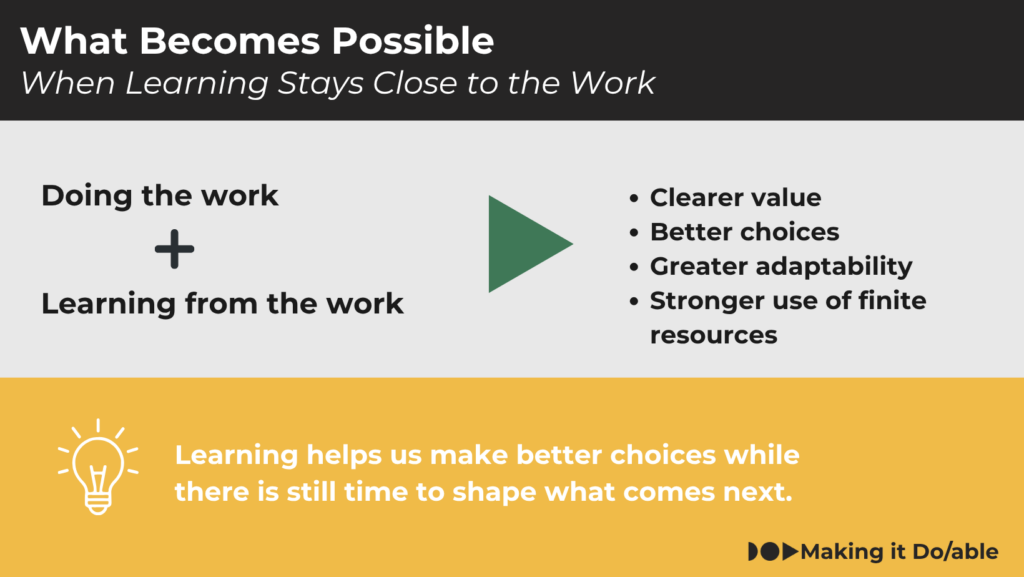
Our view is that learning belongs alongside delivery and accountability as part of the real work.
Because learning from the work is part of doing it well.
Let’s Keep the Conversation Going
This is the kind of learning we help organizations and collaboratives make space for at Do/able. We help frame the questions that matter, bring the people closest to the work and different forms of knowledge together, and facilitate shared sensemaking that helps turn what emerges into practical direction.
If you’re thinking about these concepts and interested in talking through how your organization integrates learning we’d love to have that conversation.