
There are good reasons for organizations responsible for community investment to be careful and to be aware of risk.
A change in priorities can affect organizations that have built services and staff around a longstanding relationship. Greater community influence can also make a decision more complex because it introduces perspectives that may not line up neatly. Reputation and relationships also need care. For a funder that values fairness, accountability, and continuity, moving slowly can feel like the responsible choice.
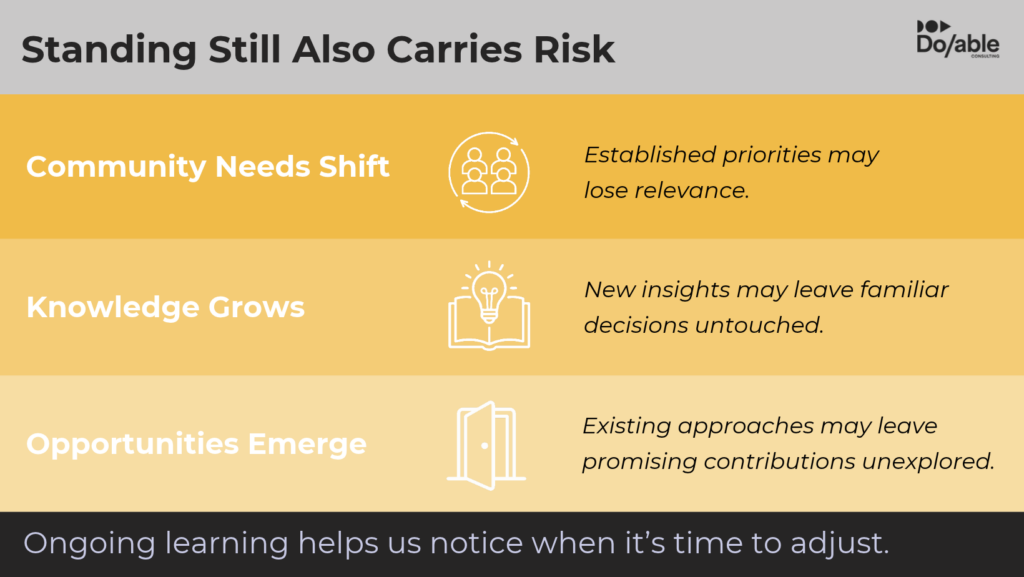
Yet there is another quieter risk that we sometimes don’t manage well on the other side. Priorities and investment approaches can keep functioning long after the community around them has changed. Needs shift, new opportunities emerge, and evidence can challenge assumptions that once felt sound. Staying the course with the same priorities and processes is still a choice about community impact, even when it feels like continuity.
That leaves us with a question we think is worth sitting with: what does responsible stewardship look like when staying the course also has risks and consequences?
When Good Investments, Stability, and Risk Management Don’t Add Up to a Strong Impact Strategy
A portfolio can look sound one grant at a time. The organizations are credible, applications have been assessed carefully, and reports show activity and reach. Yet the portfolio as a whole may still be contributing less effectively to the community and less clearly to the impact agenda than anyone intended.
One reason is that the practices that make investment safer and more manageable can also create distance from changing conditions. A longstanding priority may remain because shifting it would disrupt relationships. Engagement may gather useful input without changing the choices on the table, while reporting may become better at showing activity than at helping people learn. None of these patterns is surprising on its own; together, though, they can make it harder to notice when an investment approach is drifting from the community around it.
These patterns often grow out of legitimate efforts to create fairness, consistency, accountability, and trust. That makes the tension worth taking seriously. But, what happens when the safeguards designed to support good stewardship begin to shape the investment approach more strongly than the impact the organization is trying to contribute to?
Can community investment ever be neutral?
Keeping existing priorities and criteria in place reflects choices, just as changing them does.
Every investment approach carries decisions about which issues are in scope, what evidence carries weight, whose knowledge helps shape the picture, and how much uncertainty the organization is prepared to hold. Criteria and scoring can bring useful consistency to decisions, while still reflecting those earlier choices.
That brings the thinking underneath the process into focus for consideration from time to time. Can people see the impact the organization is trying to contribute to and what shaped that direction? Are the trade-offs understandable? Is there enough room to revisit those choices as the community and the work change? Making that thinking more visible can strengthen confidence in the decisions being made and make future learning easier.
What else might stewardship ask of a funder?
Revisiting those judgements can open a conversation about both the impact being pursued and the ways the organization is investing toward it.
An impact agenda can evolve as community conditions change, relationships deepen, and experience accumulates. What does ongoing learning suggest about the outcomes to focus on and the role the funder should play?
The same learning can shape the investment approach. Looking across the portfolio can help a funder see where investments are reinforcing one another, where something important may be missing, and what else could help move the impact agenda forward. Sometimes that may be funding. In other situations, convening, connecting organizations, sharing knowledge, supporting capacity, or creating space for joint learning may be equally useful contributions.
Seen this way, ongoing learning and adaptation become part of stewardship. They give the organization a way to keep its impact agenda and its investment choices connected to one another and to the community conditions they are intended to respond to.
Who creates community impact?
If stewardship includes learning and adapting over time, an important question follows: where does that learning come from?
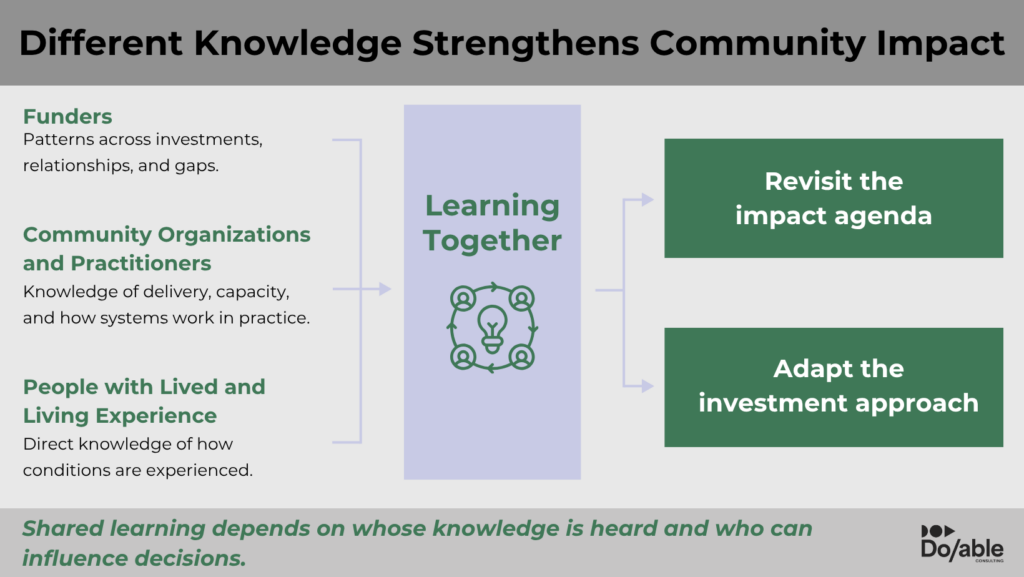
We all know that community impact is rarely the work of one actor. Funders, community organizations, practitioners, and people directly affected by an issue may all see different parts of the same picture, and each brings something the others do not.
A funder may see patterns across a portfolio, relationships among partners, or gaps that no single organization can address. Community organizations and practitioners bring practice-based expertise about implementation, capacity, and how systems behave on the ground. People with lived and living experience bring direct knowledge of how those conditions are experienced, including things formal data or institutional perspectives can miss. When those forms of knowledge can genuinely influence one another, the relationship starts to become a powerful source of shared learning.
That does not make the relationship equal. Funders still control resources, and that power shapes what can be said, what feels safe to disclose, and whose priorities ultimately carry weight. Participation also takes time, which can limit whose knowledge is heard if engagement receives little intentional support. Co-creation, to us, includes acknowledging that difference in power while creating real opportunities for community organizations and people affected by the work to influence the agenda, the approach, and the learning.
Sometimes that leads to a different kind of support, a new partnership, or a recognition that another partner is better placed to lead. More importantly, it creates a stronger basis for adapting thoughtfully as conditions change, because the funder is learning from the community.
Adaptation Does Not Have to Mean Upheaval
Most funders already know that an impact agenda or investment approach needs to evolve over time. The challenge is making room for adaptation in ways that are thoughtful, proportionate, and manageable for everyone involved.
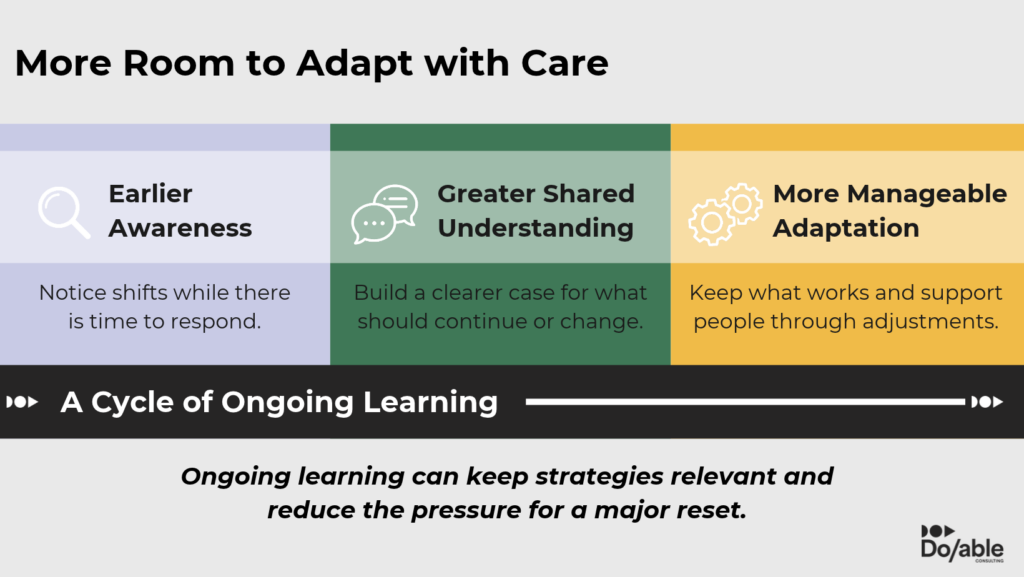
Ongoing learning helps. Staying close to what is being learned from community, partners, and the portfolio makes it easier to notice shifts earlier. That learning may confirm the current direction or point to a modest adjustment, such as a change in criteria or a new relationship.
That creates more room to make smaller changes along the way. Funders can keep what is working, adjust what needs attention, and respond in proportion to what they are learning. Over time, that can help a strategy stay useful and reduce the pressure for a major reset.
There will still be times when a more significant change is needed. Those decisions have consequences. Community organizations may have built services, staff capacity, and relationships around longstanding investments, and communities may rely on what that funding has made possible.
Strong relationships and ongoing learning can make those transitions easier to anticipate and navigate. When people have been learning together along the way, there is more opportunity to see change coming, talk about what it means, and work through the implications with care.
Ongoing adaptation helps funders stay close enough to the work to know what should continue, what may need to shift, and when. That is one of the ways an impact agenda and investment approach can remain relevant as the community changes.
Let’s Keep the Conversation Going
Many funders are already asking how well their impact agenda and investment approach are keeping pace with the community around them. Bringing others into that conversation can take time, especially when boards, staff, partners, and community members are holding different perspectives, responsibilities, and concerns.
That is the kind of work Do/able can help with. We bring an external perspective and help people make sense of the evidence and what they are seeing in practice. We facilitate conversations about where adaptation may be useful and what those choices would mean for the people affected.
Those conversations can help funders make the case for change, create confidence around the choices being considered, and bring people along in a way that is thoughtful, transparent, and manageable.
If your organization is already having these conversations and could use some support making sense of them together, we’d be glad to help.