
Why This Matters Right Now
Community-serving organizations are working in increasingly complex environments. Needs are growing, resources are stretched, and expectations continue to rise. At the same time, organizations both want and are being asked to demonstrate impact, respond to changing circumstances, and make thoughtful decisions about where to focus their time and energy.
This means communities want to know that services are meeting real needs. Staff and partners want confidence that their efforts are making a difference. And funders are looking to see that their investments are contributing to the outcomes they intend to support.
Whether you’re designing a new program, reviewing an existing service, or working alongside partners to address a complex community issue, the same questions often arise:
- What are we trying to achieve?
- Are we reaching the people we intend to serve?
- How do we know whether our efforts are making a difference?
- What should we do next?
At Do/able, we see program design, evaluation, and service review as practical ways to help organizations answer these questions. Together, they help clarify purpose, build shared understanding about the work and its intended impact, make sense of evidence, and support informed decision-making.
In busy environments, these processes create space to pause, reflect, and make decisions grounded in evidence, experience, and the realities of the communities being served.
Program Design, Evaluation, and Service Review: Three Related Ways to Strengthen Impact
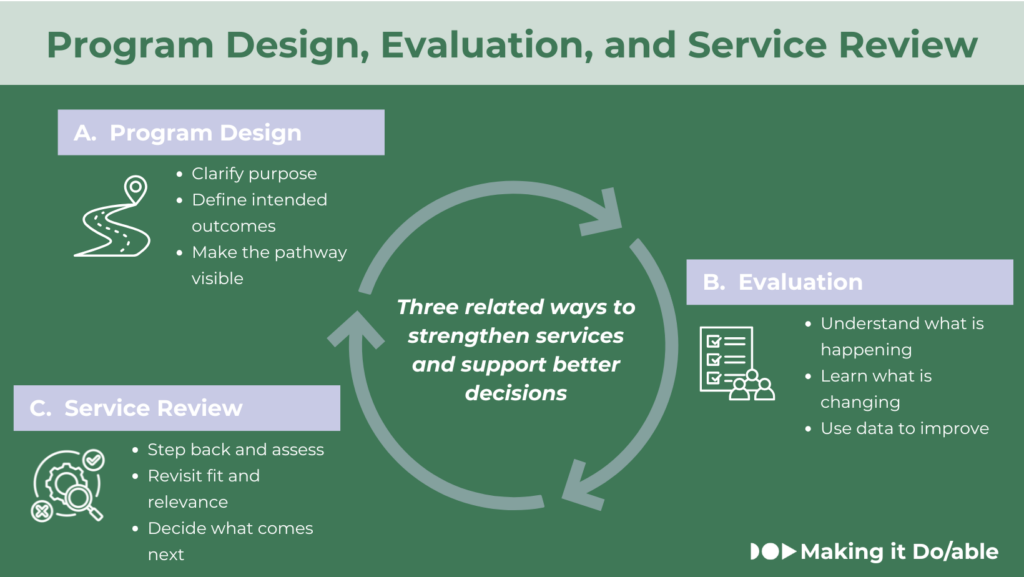
Program design, evaluation, and service review are closely connected but distinct approaches that help organizations and collaboratives understand their work, strengthen their services, and make informed decisions about the future.
Put simply, program design helps make the intended path visible. Evaluation helps organizations understand what is happening along that pathway, for whom, and under what conditions. Service review creates space to step back and decide what should continue, change, or be redesigned.
While each serves a different purpose, they are most valuable when viewed as complementary parts of an ongoing cycle of design, delivery, learning, and improvement.
Program Design
Program design is the process of intentionally planning how a program, service, or collaborative initiative will create value for the people it is intended to support. It involves understanding community needs and opportunities, defining the intended outcomes, identifying who the work is intended to serve, and determining the activities, relationships, resources, and conditions needed to support those outcomes.
Common tools in program design include logic models, theories of change, and service maps or pathways. Each makes a different part of the work visible, and the right choice depends on the questions and complexity of the work:
- A logic model helps show the relationship between resources, activities, outputs, and intended outcomes.
- A theory of change explores how and why change is expected to happen, including the assumptions and conditions behind that thinking.
- A service map or pathway shows how people experience and move through a service or system, where different roles and organizations connect, and where gaps or points of friction may exist.
Strong design creates a shared understanding of purpose and provides a practical foundation for implementation, evaluation, and future decision-making.
Program Evaluation
Program evaluation helps organizations understand what is happening as a program, service, or initiative is being delivered, who it is reaching, what people are experiencing, what outcomes are emerging, and what factors may be shaping those results. By gathering and interpreting this information, organizations can improve the work, make decisions, and communicate results and learning.
There are several different types of evaluation, each designed to answer different questions. Common approaches include:
- Needs assessment, which explores community needs and helps inform program design.
- Process evaluation, which examines how a program is being delivered and whether it is being implemented as intended.
- Developmental evaluation, which supports learning and adaptation as the work evolves.
- Outcome evaluation, which assesses whether participants or communities are experiencing the intended changes.
- Impact evaluation, which explores whether, and to what extent, observed changes can reasonably be attributed to the program itself.
At its strongest, evaluation supports both accountability and learning: what is working, for whom, under what conditions, and what may need to change. It is not only about demonstrating results. It helps organizations use evidence to improve the work, make decisions, and communicate honestly about both results and learning.
Service Review
Service review provides an opportunity to step back and take a fresh look at an existing program or service. It considers whether a service continues to meet community needs, align with organizational priorities, and have the structure, relationships, resources, and capacity to fulfil its purpose.
Questions explored during a service review often include:
- Does this service still respond to current community needs?
- Is it accessible, relevant, and achieving its intended purpose?
- Are its structure, staffing, partnerships, and resources supporting the work effectively?
- What should continue, be strengthened, change, expand, refocus, or conclude?
Service reviews often draw on multiple sources of information, including program data, participant experiences, staff perspectives, community feedback, partner perspectives, financial and operational information, and organizational priorities. They are particularly valuable when services have evolved over time, community needs have changed, partners need to revisit roles or shared direction, or organizations are considering future directions.
Why Organizations Do This Work
Organizations engage in program design, evaluation, and service review for many reasons. Sometimes the work begins with a new program that needs to be thoughtfully designed. In other cases, a program may have grown or changed without its purpose, delivery model, or intended outcomes being revisited. An organization may have considerable information without a shared opportunity to make sense of it. A long-standing service may no longer fit current needs or resources. In collaborative work, partners may need to revisit shared outcomes, roles, ways of working, or accountability.
They may want to better understand how an existing program is performing, explore opportunities to strengthen a service, or gather information to support planning, advocacy, funding applications, or strategic decision-making.
These processes also help organizations put their values into practice. For organizations that aim to be people-centred, data-informed, and responsive they provide a structured way to bring together perspectives, test assumptions, and guide decisions.
How We Approach the Work
There is no single formula for program design, evaluation, or service review.
The right approach depends on the maturity and complexity of the work, the questions or decisions the process needs to support, and the people who need to be involved.
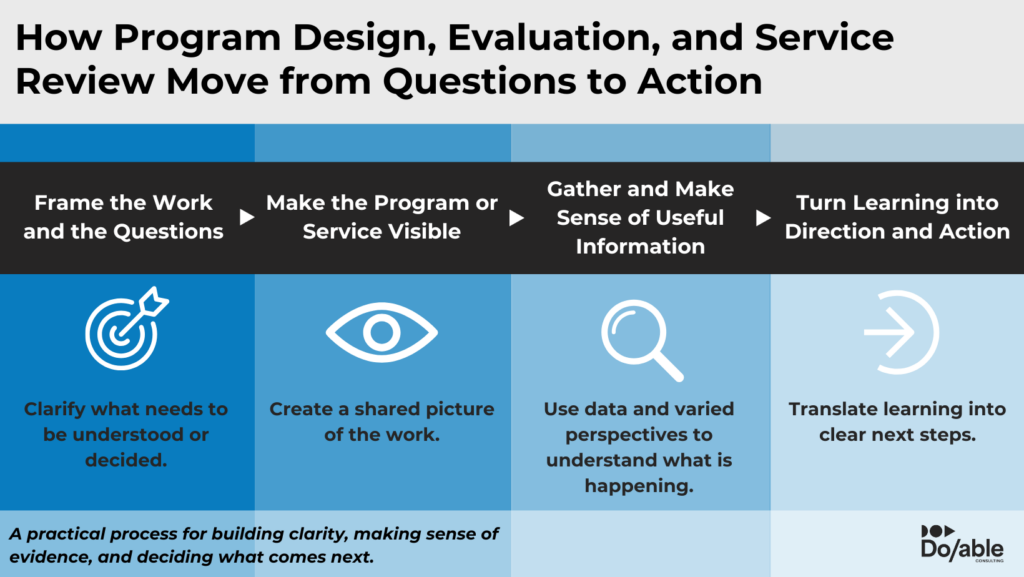
Across our engagements, five principles consistently shape how we work: we start with understanding, design collaboratively, make thinking visible, focus on evidence that matters, and keep the work practical. These principles come to life through four connected areas of work.
Frame the Work and the Questions
We begin by clarifying why the work is being undertaken and what the organization or collaborative needs to understand, design, evaluate, or decide. This means developing a shared picture of the program or service, the people it is intended to serve, the needs or opportunities it is responding to, and the organizational and community context in which it operates. We also identify the questions that should guide the work, the people whose perspectives need to inform it, and how the findings will be used.
A clear frame keeps the work focused and helps ensure that the process, methods, and level of rigour are well matched to the decisions at hand.
Make the Program or Service Visible
Program design, evaluation, and service review often require people to make explicit what may previously have been understood differently, held informally, or left unstated.
We help organizations and collaboratives develop a shared picture of the intended outcomes, activities, service pathways, relationships, resources, and assumptions that shape the work. Depending on the context, this may involve developing or refining a logic model, theory of change, service map, participant pathway, or another practical representation of the program or service.
We facilitate this work with the people closest to it. The process helps surface different perspectives, test assumptions, understand how the service is experienced, and build genuine alignment. This is especially important in collaborative or integrated services, where partners may hold different pieces of the work or understand their roles and contributions differently.
Gather and Make Sense of Useful Information
We help organizations understand what they already know, what they still need to learn, and what information will be most useful.
In program design, information may clarify community need, participant experience, or whether a proposed model is practical and responsive. In evaluation, it may help explain how a program is being delivered, who it’s reaching, what people are experiencing, and what outcomes are emerging. A service review may also consider demand, accessibility, staffing, finances, partnerships, operations, strategy, and changes in the surrounding environment.
We begin with the information already available. Where more is needed, we select methods that fit the questions, context, and people involved, which may include interviews, surveys, focus groups, facilitated conversations, observation, or analysis of program and administrative data.
Information rarely speaks for itself. An important part of our role is helping people interpret what it means. Through facilitated sensemaking, we bring different forms of data and different perspectives together, identify patterns and tensions, and consider what the findings mean for the future of the work.
Turn Learning into Direction and Action
The value of design, evaluation, and review lies in what organizations and collaboratives are able to do with what they learn.
What comes out of the process will vary. The result may be a new or refined program model, a theory of change or service pathway, an evaluation framework, recommendations for improvement, a redesigned service approach, clearer partner roles, or decisions about what should continue, change, expand, be tested further, or conclude.
We help clients translate those decisions into a practical path forward, including priorities, responsibilities, measures, and next steps. We also consider what is realistic within the organization’s capacity and how learning can continue after the formal engagement ends.
The aim is work that is technically sound, credible to the people who need to rely on it, and practical enough to guide day-to-day decisions.
What This Makes Better
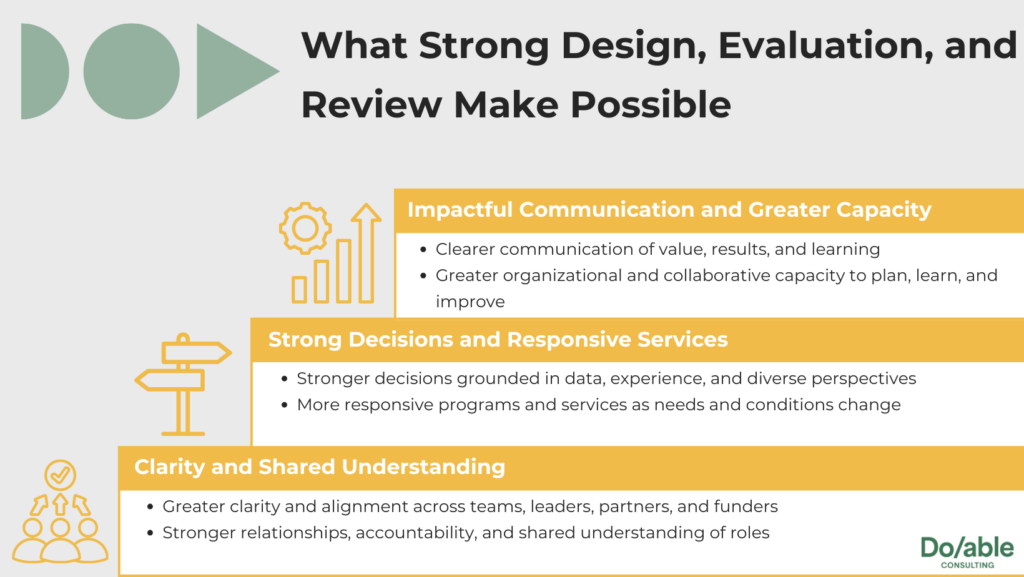
When approached intentionally, program design, evaluation, and service review help organizations and collaboratives better understand and communicate their work, make informed decisions, and respond thoughtfully to changing needs.
Over time, these approaches can help organizations and partners:
- Create greater clarity and alignment. A common understanding of purpose, outcomes, roles, and accountabilities helps teams, leaders, partners, and funders work toward shared goals, particularly across organizations.
- Strengthen relationships and accountability. Engaging people and using evidence transparently can build trust and create a clearer shared understanding of partner roles, responsibilities, and decision-making.
- Make stronger decisions. Data, experience, and diverse perspectives provide a fuller picture of what is happening and a stronger basis for deciding what should continue, change, expand, adapt, or conclude.
- Design and deliver more responsive programs and services. Understanding community needs, participant experiences, and emerging trends helps organizations design and improve services as conditions change. In collaborative services, it can also reveal gaps and transitions between organizations.
- Demonstrate value and communicate results and learning. These approaches provide a credible foundation for explaining what an organization or collaborative is doing, who it is reaching, what it is learning, and how it is responding where results are emerging or evidence is mixed.
- Build organizational and collaborative capacity. These approaches strengthen the ability to plan, reflect, learn, and improve, while leaving behind useful frameworks, measures, and learning routines that support future decisions.
An Invitation to Keep the Conversation Going
Organizations and collaboratives come to this work from different places.
Some are developing a new program or clarifying one that has evolved; others need to understand delivery, experience, and outcomes, or decide what should continue, change, or be redesigned in a long-standing service or collaborative initiative.
At Do/able, we help clients frame the right questions, involve the people closest to the work, interpret useful information, and translate learning into practical direction. Wherever you are in the process, the work is do/able.
If your organization or collaborative is beginning, revisiting, or strengthening its approach to program design, evaluation, or service review, we would be glad to explore what a practical process could look like for you.
Read on to learn more: Learning from the Work Is Part of Doing It Well